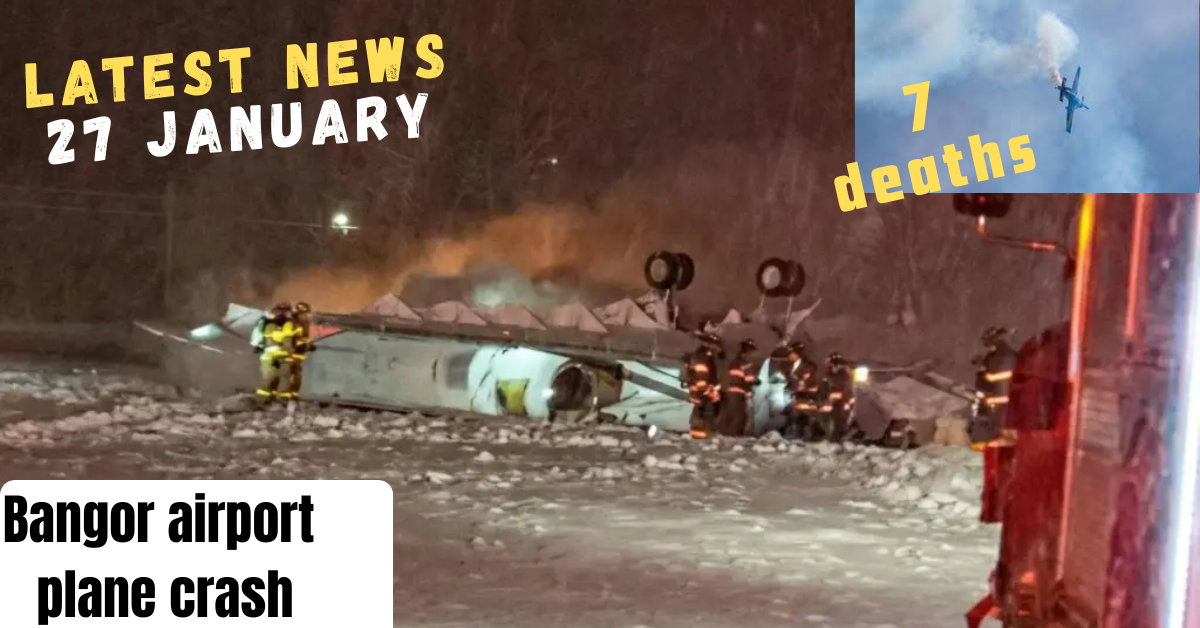
Direct answer: On Sunday evening, 25 January 2026, a Bombardier Challenger 600 private jet carrying eight people crashed during take-off from Bangor International Airport in Maine, in the middle of a snowstorm. Seven people were killed and one crew member survived with serious injuries, according to the Federal Aviation Administration (FAA). The aircraft flipped over and caught fire on the airfield at about 7:45 p.m. local time. The FAA and the National Transportation Safety Board (NTSB) are investigating, and no cause has been established.
Plane crashes Bangor Maine is the phrase many readers are searching after this deadly aviation incident at Bangor International Airport. Seven people died and one was injured when the private jet crashed during take-off on a Sunday evening in winter weather conditions. The accident resulted in an emergency response, the shutdown of the airport, and the initiation of a full federal investigation. Here is the answer-first account of the events, built on confirmed information from the authorities alone.
What Occurred at Bangor International Airport?
On Sunday evening, 25 January 2026, a private jet crashed while attempting to take off from Bangor International Airport. The aircraft had been cleared for departure and was accelerating down the runway when it encountered problems, left the runway area, came to rest upside down on the airfield and burst into flames.
Timeline of Events
- The plane was granted permission to take off from Bangor International Airport.
- At approximately 7:45 p.m. local time, the jet encountered problems during take-off.
- The aircraft crashed on the grounds of the airport and came to rest upside down.
- The plane caught fire after the crash.
- Airport firefighters and rescuers reached the scene within minutes.
- The airport was closed immediately, and the area was secured for the investigation.
The Bangor airport plane crash happened quickly, and there was no early warning that would have allowed it to be corrected. The scene was put under immediate security to assist victims and prevent additional risks. Air traffic control recordings and witness accounts described a departure in heavy snow that ended in seconds.
Casualties and Survivors
The incident resulted in seven fatalities, while one person survived with serious injuries. The Federal Aviation Administration confirmed the toll on Monday 26 January:
- The aircraft had eight occupants on board.
- Seven deaths were reported.
- One crew member, who suffered serious injuries, was evacuated to hospital and survived.
Officials released information about the casualties only after confirmation and after families had been notified. The NTSB has said it has no role in releasing information about victims, and that such information is handled by local authorities. The authorities have indicated that no further information about the survivor would be provided for now, because of privacy considerations.
There was some early confusion about the numbers: after the FAA’s initial statement, the agency told CNN it would defer to the airport on the count of people on board and those killed, while the FAA’s own Aviation Safety Information Analysis and Sharing (ASIAS) website continued to list seven total fatalities. The Associated Press continued to report seven killed and one seriously injured. The consistent figure across the FAA, the AP and other major outlets is seven dead and one survivor.
Aircraft Details
Jet Model
The aircraft in question was a Bombardier Challenger 600, a mid-size business jet. The Challenger 600 family — which includes the Challenger 650 variant — is a wide-bodied business jet that can typically carry nine to eleven passengers, with a crew of two. Some early reports described the aircraft as a Challenger 650; federal records show the aircraft involved was registered to a limited liability company based in Houston, Texas, and the FAA’s accident notification identifies it as a Challenger 600.
Ownership Information
According to federal registration records, the jet was registered to an entity located in the United States. The authorities have pointed out that ownership does not equate to responsibility, and no judgement has been given on mechanical failure, pilot actions or any other factor concerning the private jet crash in Maine. The NTSB’s investigation will examine maintenance records, flight records and the aircraft’s history before drawing any conclusions.
Weather Conditions at the Time of the Crash
The accident took place during a snowstorm with low visibility, as a massive winter storm swept across New England and much of the United States.
At the time of the incident:
- Heavy snow was falling in Bangor.
- Visibility was limited.
- Runway conditions were affected by snow and cold temperatures.
Before the crash, Bangor International Airport was operating under normal winter safety measures, including snow clearance and de-icing procedures. Investigators will assess whether the weather was a contributing factor to the plane crash at Bangor International Airport, or whether other factors — mechanical, operational or human — played a part. Weather alone is rarely the whole story in an accident like this, and the NTSB will not speculate until the evidence is examined.
The Challenger 600 and the Icing Question
One line of inquiry that drew attention immediately was the history of the Challenger 600 family. Aviation safety consultant Jeff Guzzetti told the Associated Press that this particular plane model “has a history of problems with icing on takeoff” that has caused previous crashes. The concern is well documented in aviation safety literature: ice building up on the wings can destroy lift at the precise moment an aircraft needs it most — rotation and initial climb.
It is important to be clear about what this does and does not mean. A model’s history is a line of inquiry, not a conclusion. The NTSB will examine whether de-icing was carried out, how long the aircraft waited between de-icing and take-off, what the holdover time was in the falling snow, and whether contamination was present on the wings. Until that work is done, icing is a hypothesis to be tested, not a finding. No cause has been established, and the authorities have urged the public not to speculate.
FAA and NTSB Investigation
Who Is Investigating?
The investigation is being led by:
- Federal Aviation Administration (FAA) — which issued the initial casualty confirmation and accident notification.
- National Transportation Safety Board (NTSB) — which leads the formal investigation into the probable cause.
Bombardier, the aircraft’s manufacturer, referred questions to the NTSB, as is standard practice. The airport confirmed that a single departing Bombardier Challenger 600 was involved and that NTSB investigators were expected to arrive later on Monday 26 January, although harsh weather delayed the arrival of some investigators at the site.
What Investigators Are Looking Into
Investigators will focus on:
- Wreckage and debris examination, including the condition of the wings and flight controls.
- Maintenance records and flight records of the aircraft.
- Air traffic control communications and recordings.
- Weather and runway condition data, including snowfall rates and visibility at the time of departure.
- De-icing and anti-icing procedures, holdover times and ground handling.
- The flight data recorder and cockpit voice recorder, if recovered intact.
The NTSB said preliminary information shows the plane crashed upon departure and experienced a post-crash fire, but that it would have no further statement until after investigators arrived. A preliminary report is expected within a few weeks, but the final report can take many months — and in complex cases, more than a year. Investigations into plane crashes follow a strict, evidence-based process, and the NTSB does not rush to judgement.
Impact on Travel and Airport Closures
Bangor International Airport, located about 200 miles north of Boston, closed immediately after the crash, and was not expected to reopen soon.
After the incident:
- The airport stopped flight services.
- Several flights were cancelled or diverted.
- Parts of the airport remained restricted to the investigation.
- Travellers were advised to confirm with airlines before travelling to the airport.
Airport officials said the top priority was safety and access for investigators. Bangor is a significant regional airport and a frequent refuelling stop for transatlantic flights, so the closure had knock-on effects beyond Maine. The phased reopening would depend on the NTSB releasing the wreckage and the airport completing its own safety checks.
Recent News: Updates From the Days After the Crash
26 January – Morning: The FAA confirmed seven deaths and one survivor with serious injuries. The crash scene was secured and NTSB investigators were en route.
26 January – Afternoon: Airport officials said they planned a gradual reopening once safety clearance was given. The FAA clarified it would defer to the airport on casualty figures, while its own database continued to list seven fatalities.
26 January – Evening: Officials confirmed no cause had been found and urged the public not to speculate. Reporting on the Challenger 600’s icing history began to circulate.
27 January – Morning: Investigators were still documenting the crash site. The preliminary NTSB report was expected within several weeks.
This update section will be revised as new information is confirmed. Readers should rely on the FAA and NTSB for authoritative updates, and treat social media speculation with caution.
Winter Flying: Why Take-Off in Snow Is So Demanding
Understanding why investigators focus so closely on winter conditions helps explain the care with which this investigation is being conducted. Take-off is the most demanding phase of flight, and snow adds several hazards at once: reduced visibility for the crew, contamination on the runway that affects braking and acceleration, and the risk of ice forming on the wings between de-icing and rotation.
Aircraft are de-iced with heated fluids, and the fluid gives the crew a limited “holdover time” — a window in which the aircraft must take off before snow can accumulate again. If that window is exceeded, the aircraft must return for treatment. Investigators will reconstruct the timeline minute by minute: when the aircraft was de-iced, how long it waited, what the snowfall rate was, and whether the crew carried out the required checks. This is routine, methodical work, and it is why a preliminary report takes weeks rather than days.
What Happens Next?
The investigators will release their findings in phases:
- Ongoing analysis of evidence, wreckage and recorded data.
- Publication of a preliminary report, expected within weeks.
- A final report establishing the probable cause, which can take many months.
- Formal safety recommendations if investigators identify issues that could prevent a recurrence.
If investigators find safety issues, they may issue urgent recommendations before the final report — for example, on de-icing procedures, holdover times or the operation of this aircraft type in snow. Those recommendations are how the aviation system learns from tragedy, and they are the reason the NTSB’s work matters far beyond a single airport in Maine.
Frequently Asked Questions
How many people died in the Bangor Maine plane crash?
Seven people were killed and one crew member survived with serious injuries, according to the FAA. Eight people were on board the Bombardier Challenger 600.
When did the Bangor plane crash happen?
The crash happened at about 7:45 p.m. local time on Sunday 25 January 2026, during take-off from Bangor International Airport in Maine, in the middle of a snowstorm.
What type of plane crashed at Bangor Airport?
A Bombardier Challenger 600, a mid-size business jet. Some early reports referred to the Challenger 650 variant of the same family. Federal records show the aircraft was registered to a Houston-based limited liability company.
What caused the Bangor Maine plane crash?
No cause has been established. The FAA and NTSB are investigating, and the NTSB has said only that preliminary information shows the plane crashed upon departure and experienced a post-crash fire. The Challenger 600 family has a documented history of icing-related accidents on take-off, which investigators will examine, but that is a line of inquiry, not a finding.
Did anyone survive the Bangor plane crash?
Yes. One crew member survived with serious injuries and was taken to hospital. The seven other people on board died.
Is Bangor International Airport open?
The airport closed immediately after the crash. Officials planned a gradual reopening once safety clearance was given, but parts of the airport remained restricted to the investigation. Travellers were advised to check with their airline before travelling.
Conclusion
The deadly accident at Bangor International Airport has raised essential questions about aviation safety and winter operating procedures. The federal investigation is ongoing to determine the causes of the Bangor Maine plane crash, which remain unknown at this time. Authorities continue to stress the need to rely on confirmed information as the investigation proceeds.
Seven families are grieving, one crew member is recovering from serious injuries, and an entire airport community is coming to terms with a tragedy that unfolded in seconds on a snowy Sunday evening. The best tribute to those who died is a thorough, honest investigation — one that establishes what happened, why it happened, and what must change so that it does not happen again. This article will be updated as the facts become clearer, giving travellers, families and the aviation community a better understanding of the actions that follow.
For more on aviation safety and travel disruption, see our report on American Airlines headaches beyond the tech outage.
Sign up for our Daily newsletter
We'll be in your inbox every morning Monday-Saturday with all the day’s top business news, inspiring stories, best advice and reporting from Entrepreneur,