Short answer: A 25G SFP28 Active Optical Cable (AOC) is a pre-terminated fibre cable with SFP28 transceivers built into each end. It carries 25 Gigabit Ethernet at up to 25.78 Gbps over multimode fibre — up to 70 metres on OM3 and up to 100 metres on OM4 — using an 850nm VCSEL laser, at roughly 0.8W per end. It is lighter, more flexible and far longer-reaching than a copper direct-attach cable, and simpler and cheaper to deploy than separate transceivers plus patch fibre, which makes it a standard choice for high-density data-centre, cloud and high-performance computing links.
As the demand for high-speed, high-density networks continues to rise in data centers, cloud computing, and enterprise environments, organizations require network solutions that provide not only speed and reliability but also efficiency and flexibility. One such solution gaining traction in modern networking is the 25G SFP28 Active Optical Cable (AOC). This technology plays a crucial role in meeting the bandwidth requirements of contemporary networking environments while offering a host of benefits over traditional copper-based connections.
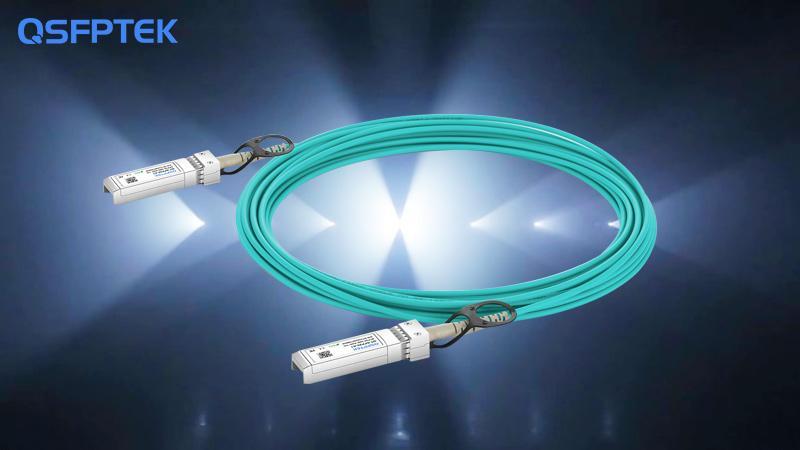
What is 25G SFP28 AOC?
The 25G SFP28 AOC is a high-performance networking cable that combines SFP28 transceivers with active optical cables. Unlike standard copper cables or passive optical cables, AOCs utilize optoelectronic components to convert electrical signals into optical signals for long-range transmission. The SFP28 connector refers to a small form-factor pluggable transceiver that supports data rates of up to 25 Gbps. When paired with an active optical cable, it provides a fast, reliable, and flexible medium for data transmission, typically used in high-speed network applications.
It helps to unpack the name. “25G” is the data rate: 25 gigabits per second. “SFP28” is the connector form factor — the enhanced small form-factor pluggable standard that succeeded SFP+ and is designed for 25G lanes (the same footprint is also used for 10G SFP+ in many switches). “Active” means the cable contains powered electronics: a laser transmitter at one end and a photodiode receiver at the other, so the cable itself performs the electrical-to-optical conversion. “Optical” means the signal travels as light through multimode fibre rather than as electricity through copper. Because the transceivers are permanently attached at the factory, an AOC is a single plug-and-play assembly: there are no separate optics to buy, no fibre patch cords to match, and no cleaning or mating of connectors in the field.
Key Specifications at a Glance
Specifications vary slightly by vendor, but the figures below are typical of 25G SFP28 AOC assemblies from major manufacturers such as FS and Siemon, and are worth checking against any datasheet before you buy:
- Data rate: 25.78125 Gbps per lane (25G Ethernet, also backwards compatible with 10.3125 Gbps in many implementations)
- Reach: up to 70 m over OM3 multimode fibre; up to 100 m over OM4 multimode fibre; lengths commonly sold from 1 m to 100 m
- Wavelength: 850 nm VCSEL transmitter with PIN photodiode receiver
- Fibre type: OM3 or OM4 multimode fibre, typically 3.0 mm cable diameter
- Power consumption: maximum around 0.8–1.0 W per end, from a single 3.3 V supply
- Operating temperature: 0 °C to 70 °C case temperature; storage −40 °C to 85 °C
- Diagnostics: digital diagnostic monitoring (DDM/DOM) via the 2-wire interface, reporting temperature, supply voltage, transmit and receive power
- Standards: SFP28 MSA, SFF-8431 and SFF-8432, IEEE 802.3by 25GBASE-SR, RoHS compliant
- Other: hot-swappable, EMI-shielded SFP28 housing, minimum bend radius around 20× the cable outer diameter without tension
Note the two reach figures carefully: the 100 m maximum applies to OM4 fibre, while OM3 is generally rated to 70 m. If your run is between 70 m and 100 m, OM4 is required. Beyond 100 m, a 25G AOC is the wrong tool — you need separate 25GBASE-LR single-mode optics instead.
Advantages of 25G SFP28 AOC
High-Speed Data Transmission
The primary advantage of the 25G SFP28 AOC is its ability to support data transmission at 25 Gbps, which is crucial for modern data centers, cloud services, and high-performance computing applications. This high data rate ensures that organizations can meet the ever-increasing demand for faster data transfers, especially as workloads and applications continue to become more complex and data-intensive.
25G is a particularly efficient step up from 10G. Because 25G uses a single 25 Gbps lane, it delivers two and a half times the bandwidth of 10G over the same number of switch ports, and it maps neatly onto 100G switching: one 100G port can be broken out into four 25G links. That is why 25G has become the standard server-access speed in modern data centres, replacing 10G as the default for new deployments.
Reduced Power Consumption
One of the most appealing features of 25G AOC cables is their energy efficiency. Unlike traditional copper cables, which consume more power due to the electrical signals they carry, AOCs are designed to deliver high-speed performance with lower power consumption. This translates to a reduction in operational costs and energy bills, particularly important for large-scale data centers and cloud service providers who seek to minimize their environmental footprint while maximizing performance.
At under 1 W per end, an AOC typically draws less power than a copper DAC at the same reach and far less than some active copper solutions, while also generating less heat inside the rack. Across thousands of links, that difference shows up in both the electricity bill and the cooling load.
Long-Distance Transmission
While copper cables are often limited in terms of distance, 25G SFP28 AOCs can transmit data over much longer distances — typically up to 100 meters or more. This capability makes them an ideal solution for data center interconnects and high-speed links across large campuses or distributed infrastructures, where long-distance connections are required without the signal degradation or latency associated with copper cables.
For context, a passive copper DAC is generally practical only up to about 5 m at 25G, and an active copper cable reaches roughly 7–10 m. An AOC therefore covers the whole range from a few metres to a hundred, including the awkward middle distances — between rows, or from a top-of-rack switch to an end-of-row aggregation switch — where copper cannot reach and separate optics would be overkill.
Flexibility and Scalability
AOCs are lightweight and flexible, making them easier to manage and deploy in high-density networking environments. Their flexibility allows for easy cable routing, reducing the clutter typically seen with rigid fiber optic or copper cables. Additionally, their compact design is ideal for environments where space is at a premium, such as in rack-to-rack connections or high-density server configurations. As data center infrastructures grow, the scalability of 25G AOC cables becomes increasingly important, as they can easily accommodate network upgrades to meet higher data rate demands.
The thin 3 mm fibre cable also improves airflow compared with thick copper bundles, which matters in racks packed with high-power servers. Smaller cable bundles mean better cooling, easier tracing of individual links, and less strain on switch ports.
Applications of 25G SFP28 AOC
The 25G SFP28 AOC plays a critical role in several key applications, ranging from data centers to cloud computing and enterprise networks. Let’s explore how these cables help optimize network infrastructure in various environments:
Data Centers
In a data center, efficient interconnectivity between servers, storage devices, and network switches is essential for seamless communication and data processing. 25G SFP28 AOC cables provide high-speed, low-latency connections between different components, ensuring that data is transferred quickly and reliably. With rack-to-rack interconnects, the flexibility and long-distance transmission capabilities of AOCs make them an ideal solution for data center operators looking to reduce cable clutter and streamline deployments.
Cloud Computing
Cloud service providers rely on high-performance networks to support a wide range of applications and services. 25G AOCs offer cloud providers a reliable and energy-efficient way to connect servers, storage systems, and switches, ensuring smooth data transmission between different data centers and cloud infrastructure. The high bandwidth and low latency offered by AOCs are essential for handling large-scale cloud applications, including big data analytics, video streaming, and real-time data processing.
Enterprise Networks
Enterprises often require robust, scalable networks that can handle the demands of growing user bases and increasing data traffic. 25G AOCs allow businesses to connect various network devices, such as servers, routers, and switches, while maintaining the performance needed for smooth operation. In an increasingly digital world, where enterprises rely on cloud applications and data sharing, the efficiency of 25G SFP28 AOCs provides a significant advantage in ensuring connectivity without compromising on performance.
High-Performance Computing (HPC)
In high-performance computing (HPC) environments, where complex simulations and data-intensive applications are run, network performance is critical. The fast data transfer speeds enabled by 25G AOCs ensure that large datasets are transferred quickly between nodes, minimizing bottlenecks and maximizing overall system performance. This is particularly important in fields like scientific research, financial analysis, and simulation-based industries.
Storage Networks
Storage is often overlooked, but it is one of the best fits for 25G AOCs. All-flash storage arrays and hyper-converged infrastructure generate heavy, latency-sensitive traffic between storage nodes and compute nodes. AOCs provide the low latency and consistent throughput that storage protocols such as NVMe over Fabrics and iSCSI demand, without the distance limits that would force a more expensive optical design.
Comparison: 25G SFP28 AOC vs. Copper Cables and DAC
When compared to copper cables and direct attach copper (DAC) cables, 25G AOCs offer a number of clear advantages:
Performance: AOCs provide faster data rates and support longer distances than copper cables and DACs, making them ideal for high-density, high-speed applications.
Power Efficiency: AOCs are more energy-efficient than copper solutions, which helps reduce operational costs, particularly in large-scale environments.
Flexibility: The lightweight and flexible nature of AOCs makes them easier to install and manage, reducing cable clutter and simplifying network expansion.
| Feature | 25G SFP28 AOC | 25G DAC (passive copper) | 25G SR transceiver + fibre |
|---|---|---|---|
| Max reach | 70 m (OM3) / 100 m (OM4) | ~5 m | 70 m (OM3) / 100 m (OM4) |
| Power per end | ~0.8–1.0 W | ~0.1–0.5 W | ~1.0 W |
| Cost | Moderate | Lowest | Highest |
| Flexibility | High — thin, light fibre | Low — stiff, heavy copper | High |
| Field repair | No — replace whole cable | Replace cable | Yes — swap optic or patch cord |
| Best for | 3–100 m high-density links | Within-rack links under 5 m | Links needing reconfiguration |
The choice is usually straightforward: DAC for short links inside a rack, AOC for anything from a few metres to 100 m where the link is unlikely to change, and separate transceivers with patch fibre where you need the ability to re-route or replace parts independently. An AOC guide from the manufacturer explains the same trade-offs in more depth.
How to Choose the Right 25G SFP28 AOC
Choosing an AOC is mostly a matter of matching the cable to your switches and your distances:
- Measure the run first. Order the length you need plus sensible slack for routing — but not far more, since excess fibre must be stored tidily to avoid bend damage. Lengths are typically sold in 1 m steps up to 100 m.
- Check fibre grade. Runs up to 70 m can use OM3; runs up to 100 m need OM4. Confirm which grade your vendor supplies.
- Confirm switch compatibility. AOCs are coded for specific vendors (Cisco, Juniper, Arista, Dell and others). A cable coded for one vendor may be rejected by another switch, so buy the correct coding or a verified compatible part.
- Check the operating environment. Standard AOCs are rated 0–70 °C; if your environment is hotter, look for industrial-temperature variants.
- Consider the jacket rating. OFNR (riser) and LSZH (low-smoke zero-halogen) jackets are available for different building codes — check what your facility requires.
- Verify DDM support. Digital diagnostics let you monitor temperature, voltage and optical power from the switch, which makes troubleshooting far easier.
Installation and Troubleshooting Best Practices
AOCs are plug-and-play, but a few habits prevent most problems. Keep the protective dust caps on until the moment of installation, and never look into a live fibre end. Respect the minimum bend radius — about 20 times the cable diameter without tension — and never pull an AOC by the cable itself; use the pull tab on the connector. Route fibre away from sharp edges and power cables, and leave service loops rather than tight coils.
If a link does not come up, check the obvious first: confirm both ends are fully seated, verify the switch recognises the cable (an incompatible vendor code is the most common cause of a dead link), inspect the DDM readings for abnormal temperature or low receive power, and swap in a known-good cable to isolate whether the fault is the cable or the port. Because an AOC is a sealed assembly, a faulty cable is replaced as a unit — there is nothing to repair in the field, which is the price of its simplicity.
How 25G SFP28 AOC Supports Future Network Demands
As data traffic continues to grow, especially with the rise of cloud computing, IoT, and 5G, the demand for high-speed, scalable, and flexible network solutions will only increase. 25G AOCs are well-positioned to meet these demands by offering a future-proof solution that supports higher data rates and long-distance transmission. Their ability to scale easily with growing network infrastructures ensures that organizations can continue to meet their bandwidth needs without significant changes to their physical network setup.
The longer-term picture is a migration path: the same SFP28 ecosystem extends to 50G and 100G over similar fibre, and the operational habits built around 25G — breakout architectures, fibre-first thinking, DDM-based monitoring — carry directly into those faster generations. Investing in 25G AOC infrastructure today therefore does not lock a network into a dead end; it builds the foundation for the next upgrade.
Conclusion
The 25G SFP28 AOC represents a key advancement in modern networking technology, offering high-speed data transmission, energy efficiency, long-distance connectivity, and flexibility. Whether used in data centers, cloud computing, enterprise networks, or HPC environments, these cables help optimize network performance, simplify deployments, and reduce operational costs. As demand for faster and more efficient networks continues to rise, 25G AOCs will play a critical role in ensuring that modern network infrastructures can meet the challenges of tomorrow’s digital world.
Frequently Asked Questions
What is a 25G SFP28 AOC?
A 25G SFP28 Active Optical Cable is a pre-terminated multimode fibre cable with SFP28 transceivers permanently built into both ends. It converts electrical signals to optical signals inside the cable and carries 25 Gigabit Ethernet at up to 25.78 Gbps.
How far can a 25G SFP28 AOC reach?
Typically up to 70 metres over OM3 multimode fibre and up to 100 metres over OM4 multimode fibre. Most vendors sell lengths from 1 m to 100 m. Beyond 100 m you need single-mode optics instead.
What is the difference between an AOC and a DAC?
A DAC (direct attach copper) cable carries electrical signals over copper and is practical only up to about 5 m at 25G. An AOC carries optical signals over fibre, reaches up to 100 m, is lighter and more flexible, and uses slightly more power. DAC is cheaper for very short links; AOC wins for anything longer.
How much power does a 25G SFP28 AOC use?
Typically a maximum of around 0.8–1.0 W per end from a single 3.3 V supply, with an operating temperature range of 0 °C to 70 °C. Exact figures vary by vendor, so check the datasheet for the part you buy.
Are 25G SFP28 AOCs compatible with all switches?
Physically, SFP28 is a standard form factor, but AOCs are coded for specific switch vendors and a switch may reject a cable with the wrong coding. Always order the cable coded for your switch brand, or a third-party cable verified as compatible with it.
Can I repair a faulty AOC?
No. An AOC is a sealed factory assembly with the transceivers permanently attached. If it fails, replace the whole cable. Keep a spare of each common length on site so a failed link can be restored in minutes.
Sign up for our Daily newsletter
We'll be in your inbox every morning Monday-Saturday with all the day’s top business news, inspiring stories, best advice and reporting from Entrepreneur,